



From one finished task to a method your agent can reuse.
Facts tell your agent what. Procedures tell it how.
Memories
What is true: decisions, rules, preferences and lessons.“Errors always use the
{ code, message } format.”Procedures
How something was done: steps, context and warnings from a task that worked.“Add an endpoint: define the route, validate input, write tests, update the API docs.”
How a procedure is born
1
Your agent finishes a task
It closes the task and, if it used a method worth keeping, saves it.
2
Slowave stores the method
A procedure has a goal, ordered steps, the situation it applies to, and any warnings.
3
A similar task comes along
When your agent starts a related task, Slowave offers the procedure as a head start.
4
Your agent rates it
Did it help? Procedures that keep helping are offered more often.
What a procedure looks like
Example: shipping a hotfix
Example: shipping a hotfix
Goal: Ship a fix to production without a full release.
- Branch from the last release tag.
- Apply the fix and run the full test suite.
- Open a pull request against the release branch.
- After approval, merge and run the deploy pipeline.
- Watch error rates for 15 minutes.
Good to know
Procedures are advice, not orders
Procedures are advice, not orders
Your agent decides what to do. A procedure is a tip from past work. Your agent decides whether to follow it.
Failures are kept as warnings
Failures are kept as warnings
If a method didn’t work, Slowave keeps it and labels it as a caution. Your agent learns what to avoid.
You can see every procedure
You can see every procedure
The Procedures view in the dashboard lists them, with when each was offered and whether it helped.
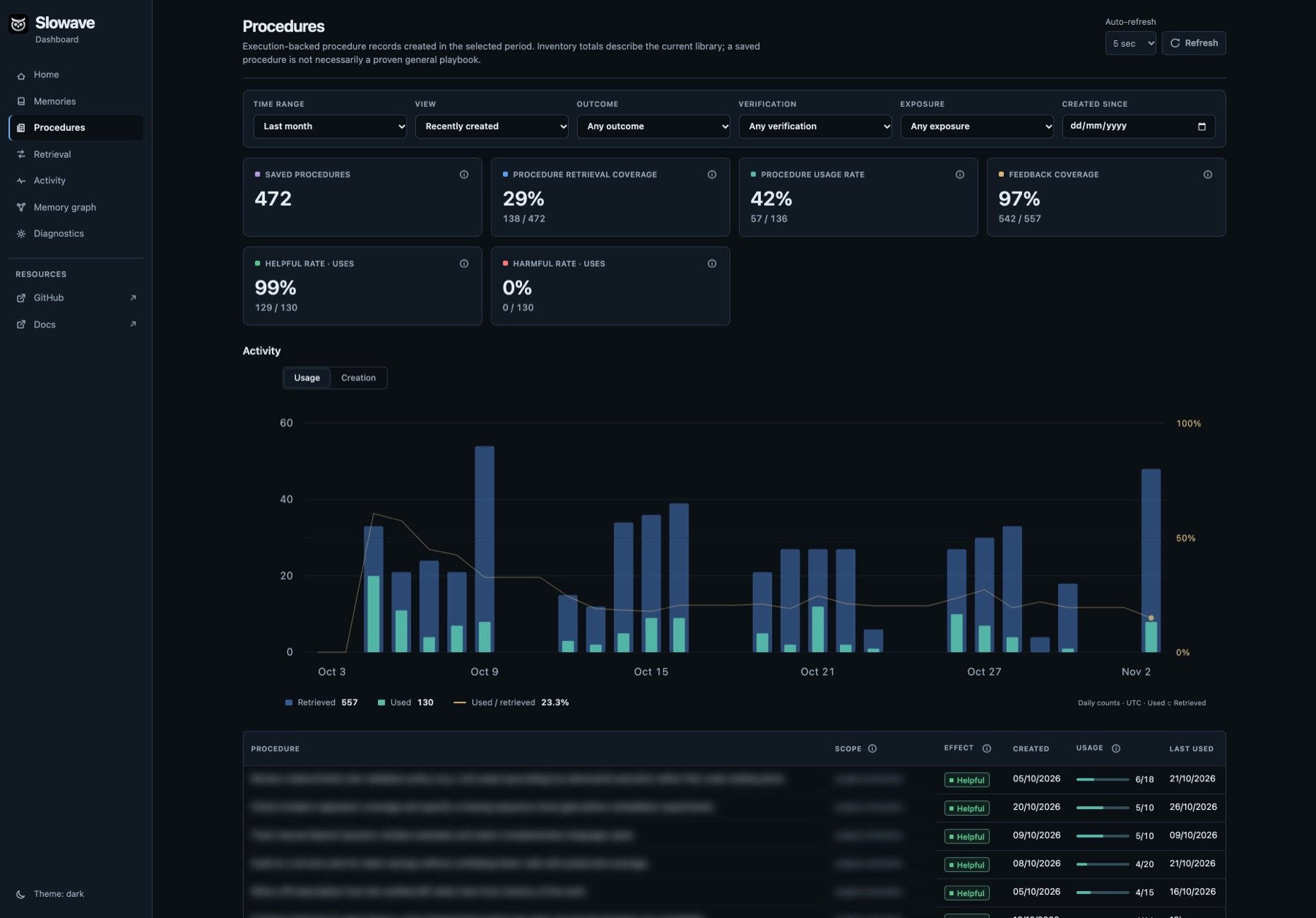
The Procedures view in the dashboard. Example data.
Next: where your data lives
Everything stays on your computer.